
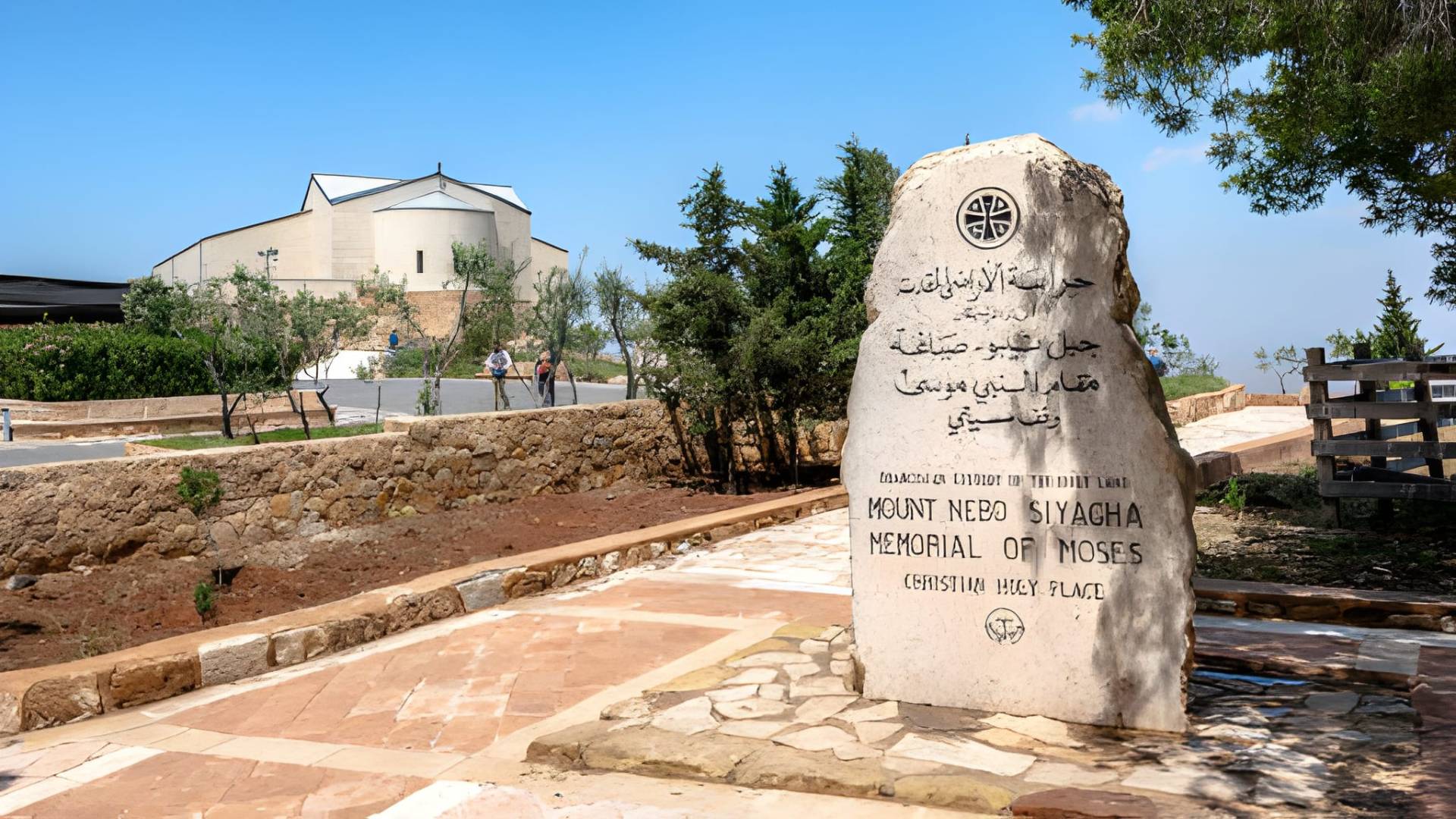
Mount Nebo, located in the Kingdom of Jordan, stands as one of the most significant biblical landmarks in the Holy Land. According to Scripture, it was from this mountain that Moses looked out across the Promised Land before his death (Deuteronomy 34:1–5). For Christians, Mount Nebo represents faith, fulfillment, and divine promise — a place where God’s covenant and human hope meet in a single, breathtaking view.
Rising over 800 meters (2,600 feet) above sea level, Mount Nebo offers a panoramic view of the Jordan Valley, the Dead Sea, and on clear days, even the distant hills of Jerusalem. Pilgrims who stand on its summit often describe a profound spiritual connection to the journey of Moses and the generations of believers who have followed his path of faith.
Biblical Significance: Moses and the Promised Land
In the Book of Deuteronomy, God leads Moses to Mount Nebo after forty years of guiding the Israelites through the wilderness. From the summit, God shows him the land promised to Abraham, Isaac, and Jacob — the land flowing with milk and honey.
“Then Moses climbed Mount Nebo… There the Lord showed him the whole land… Then the Lord said to him, ‘This is the land I promised on oath to Abraham, Isaac, and Jacob… I have let you see it with your eyes, but you will not cross over into it.’” (Deuteronomy 34:1–4)
Moses’ view from Mount Nebo marks both an ending and a beginning — the completion of his earthly mission and the continuation of God’s promise through His people. For Christians, it also prefigures the eternal promise of salvation fulfilled through Jesus Christ.
Historical and Archaeological Background
Mount Nebo has been a revered pilgrimage destination since the earliest centuries of Christianity. Archaeological excavations have revealed the remains of a Byzantine monastery and a church built by early Christian monks in the 4th century. These sacred structures were constructed to honor Moses and to commemorate the place where he glimpsed the Promised Land.
The most prominent structure today is the Memorial Church of Moses, which has been carefully restored and preserved. The church features a stunning collection of Byzantine mosaics, depicting animals, plants, and pastoral scenes symbolizing life and creation. These mosaics, dating from the 6th century, are among the finest examples of early Christian art in the region.
In 2000, Pope John Paul II visited Mount Nebo during his pilgrimage to the Holy Land, followed by Pope Benedict XVI in 2009 and Pope Francis in 2014 — further affirming its global importance as a sacred site of faith and peace.
The Memorial of Moses
At the heart of Mount Nebo stands the Moses Memorial, a symbolic monument that marks the spot where the prophet viewed the Promised Land. Outside the church, a large bronze serpent cross sculpted by Italian artist Giovanni Fantoni recalls the serpent lifted by Moses in the wilderness (Numbers 21:4–9), a symbol of healing and salvation that foreshadows Christ’s crucifixion.
The memorial serves as a reminder of faith’s endurance — even when fulfillment lies just beyond reach. For pilgrims, it is a place to reflect on life’s journey, perseverance, and the eternal promises of God.
Spiritual Meaning of Mount Nebo
Mount Nebo holds deep spiritual symbolism. It represents vision, faithfulness, and hope — themes central to the Christian journey. Like Moses, every believer is called to trust in God’s plan, even when the full promise is not yet seen.
Standing on Mount Nebo’s summit invites reflection on the nature of faith: it is a journey, not a destination. The mountain’s breathtaking view serves as a metaphor for spiritual vision — the ability to see beyond the present struggles toward God’s eternal promise.
Many pilgrims describe Mount Nebo as a place of peace and divine perspective. The silence of the desert, the sweeping horizon, and the sacred history create an atmosphere of reverence and awe.
Pilgrimage Experience Today
Modern pilgrims to Mount Nebo can explore the archaeological park, the church, and the mosaic exhibition halls that preserve centuries of Christian devotion. The site is managed by the Franciscan Custody of the Holy Land, which maintains it as a place of prayer and historical preservation.
The panoramic viewpoint is a highlight of any visit. From here, travelers can see the Jordan River Valley, the Dead Sea, and the hills leading to Jerusalem and Bethlehem. These vistas connect the Old and New Testaments — from Moses viewing the Promised Land to Jesus’ ministry in that very region.
The combination of sacred heritage, stunning landscapes, and historical depth makes Mount Nebo a must-visit site for anyone exploring the biblical roots of Christianity.
A Place of Promise and Peace
Mount Nebo stands as a living monument to the enduring faith of God’s people. It reminds every visitor that the journey of faith is one of trust, perseverance, and divine revelation.
As pilgrims stand where Moses once stood, they are invited to renew their own commitment to God’s promise — to see beyond the horizon of this world toward the eternal Promised Land.
In every sense, Mount Nebo remains a mountain of promise, vision, and peace, a timeless symbol of God’s faithfulness and the fulfillment of His covenant.